Start with the speakers, then match the ports
- Powered speakers and soundbars connect straight to the TV. Passive speakers need an amplifier or receiver in between.
- Use HDMI ARC or eARC if both the TV and the audio system support it. Otherwise use optical or the TV's analog audio output.
- Then choose the external audio system in the TV's sound settings and the matching input on the speakers.
- Connected but silent? Check the output, input and audio format before you buy anything else.
We'd work out what's doing the amplifying before you buy a single cable. A cable that fits both ends can still leave you without an amplifier, or sending a format your speakers can't play. After that, match the ports, check the format and decide which remote will run the volume.
Port labels and menu names depend on both models, so keep both manuals nearby as you go.
Work out the path from the TV to the speakers
Powered speakers have their own amplifier, but in a stereo pair it may sit in only one of the two cabinets. On the Kanto YU4, the active left speaker drives the passive right one through speaker wire, so the TV's audio output goes into the active speaker. Never connect that pair's speaker terminals to a stereo amplifier's speaker connections, because that can cause damage.
| Connection | TV side | Audio system side |
|---|---|---|
| HDMI ARC/eARC | HDMI IN marked ARC or eARC/ARC | The audio system's ARC/eARC return port, such as HDMI OUT or TV OUT |
| Optical | Digital optical audio OUT | Optical IN on powered speakers, a soundbar, a receiver or a suitable DAC |
| Analog | The analog audio OUT listed in the TV's manual | A compatible ANALOG IN, AUX or RCA line input |
| Passive speakers | The TV's audio output goes to the amplifier first | The amplifier's SPEAKERS outputs go to the speaker terminals |
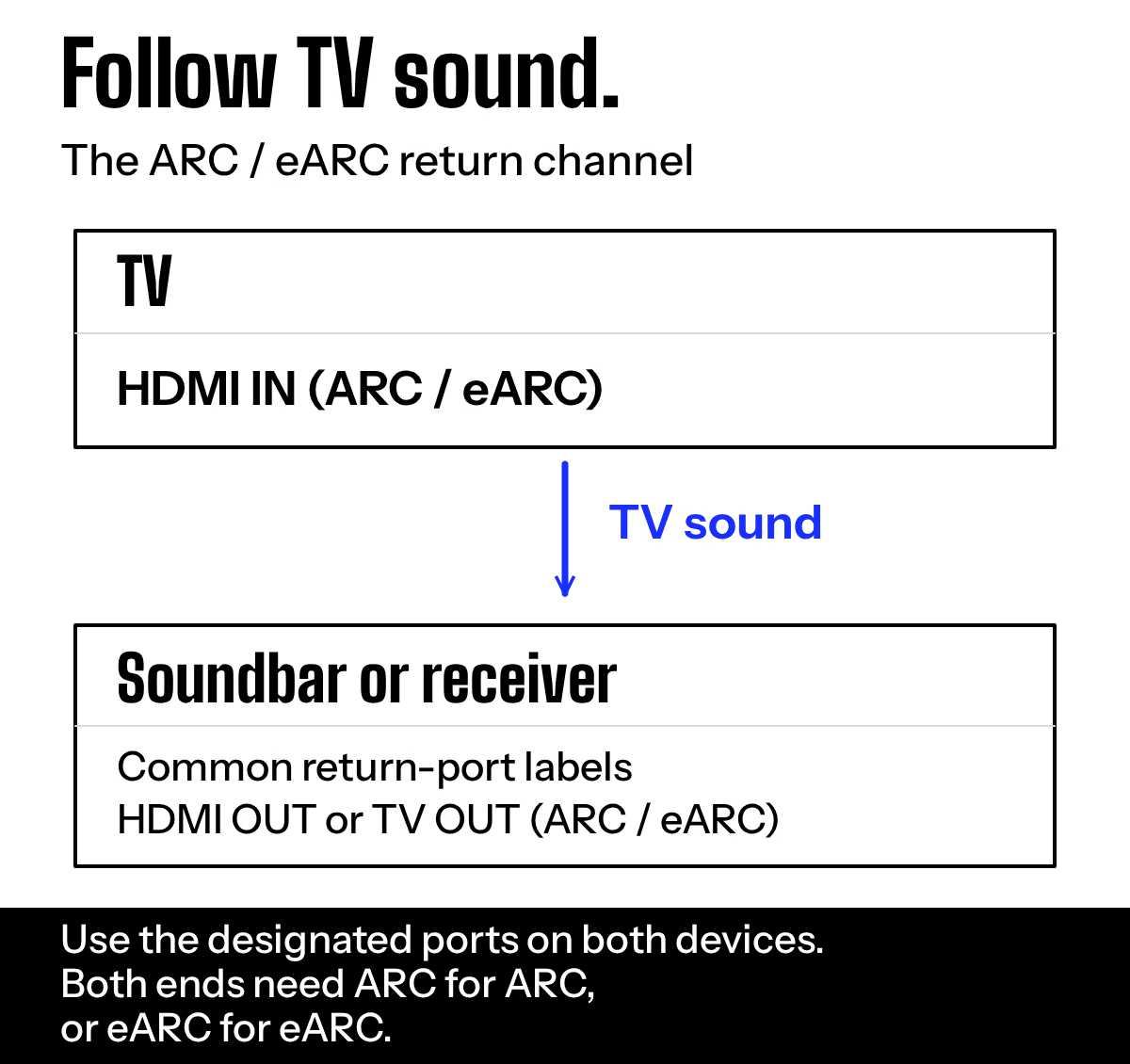
HDMI labels can look backward. With ARC, TV sound travels out through one of the TV's HDMI inputs and into the audio system's HDMI output, and both devices have to support the return channel. If only one does, pick another route.
If both ends do support ARC or eARC, we'd start there, because with compatible HDMI control set up, the TV remote can change the audio system's volume too. Check each manual for the right port, since some soundbars don't print ARC next to it.
Connect powered speakers or a soundbar
Switch everything off before you connect cables, and follow any extra steps in your models' manuals. On the Kanto YU4, set the rear ON/OFF switch to OFF and only turn it on again once every cable is in.
For HDMI ARC or eARC, connect the TV's HDMI input marked ARC or eARC to the audio system's return port, using a cable that meets both devices' requirements. The Yamaha RX-V4A needs one that supports ARC/eARC, such as a High Speed HDMI Cable with Ethernet.
For optical, connect the TV's digital optical output to the audio system's optical input. On a Sony A95L, attach the Digital Audio Adapter to the optical cable before you plug it into the TV.
For analog, connect the TV's audio output to a compatible line input. On the YU4's switchable RCA input, choose Line for a line-level source like this, not Phono. Phono is the setting for a turntable without a built-in preamp, and Kanto warns that using it with a turntable that has one could severely damage the speakers and void the warranty.
Now turn everything on. Choose the external audio system in the TV's sound settings, then select the matching input on the speakers or soundbar. On the YU4 remote that's RCA, AUX, OPT1 or OPT2, whichever matches your cable.
HDMI connections also need the return-channel settings both devices ask for. On the RX-V4A, press SETUP, set HDMI > HDMI Control to On and HDMI > ARC to On for ARC, then press SETUP again to finish. eARC doesn't need the ARC setting, but if HDMI Control is off while you use eARC, select TV as the receiver's input yourself.
For a digital connection, set the TV to an output format the receiving device supports. The YU4's optical input (opens in a new tab) takes stereo PCM at 96 kHz or lower, not Dolby, DTS, surround or 5.1, though a surround-capable receiver or soundbar may handle those.
Keep an amplifier between the TV and passive speakers
Passive speakers need an amplifier to drive them, so the path runs from the TV's audio output to the amplifier's input, then from the amplifier's speaker outputs to the speakers. Check the amplifier's impedance requirement before you wire anything.
US and Canadian RX-V4A models take 8-ohm speakers, or 6-ohm speakers with the right setting. Other regional RX-V4A models need at least 6 ohms.
Here's how bare speaker cable goes into the RX-V4A's speaker terminals (opens in a new tab):
- Unplug the receiver's power cable from the wall outlet. Prepare the speaker cables away from the receiver, so no loose strands can drop inside and cause a short circuit.
- Strip about 10 mm (3/8 inch) of insulation from each cable end and twist the bare strands firmly together.
- Loosen each speaker terminal, push the bare wire into the gap on its side, then tighten the terminal. Match positive to positive and negative to negative.
- Check that no bare wire touches another or the receiver's metal rear panel or screws, since a short can damage the receiver or the speakers. If “Check SP Wires” appears when you turn it on, turn the receiver off and unplug it before you fix the wiring.
Once it's wired and powered back up, US and Canadian RX-V4A owners with 6-ohm speakers need to press SETUP, choose Speaker > Speaker Impedance > 6Ω MIN, then press SETUP to finish. Use 8Ω MIN for speakers of 8 ohms or higher.
TV has optical out but the stereo only has analog inputs? Add a powered optical-to-analog DAC, so the path becomes TV optical OUT → DAC optical IN → DAC analog OUT → amplifier line input. An adapter cable only changes the plug, not the signal, and the DAC doesn't drive speakers, so the amplifier stays in the chain.
The FiiO D03K (opens in a new tab) is one example, with selectable optical and coaxial inputs and RCA or 3.5 mm stereo outputs. Select its optical input and power it with the specified DC 5 V through its USB power connection, which isn't a TV audio input. Set the TV to stereo PCM first, because the D03K can't decode Dolby, DTS or other multichannel input (opens in a new tab).
Pick the remote that will run the volume
Once you have sound, try the remote you actually plan to use. With a compatible HDMI control setup, the TV remote can change the audio system's volume, and BRAVIA Sync-compatible equipment is one example.
Optical doesn't carry that HDMI control link, so plan on using the audio system's own volume control unless it supports a separate remote setup. Sonos home theater products connected by optical (opens in a new tab) only take volume commands from an IR remote, and RF or Bluetooth remotes can't control their volume that way.
An analog AUDIO OUT can be fixed or variable. A fixed output stays at one level whatever you press on the TV remote, so use the audio system's volume control instead, while a variable output follows the TV remote's volume buttons.
If your Sony Android TV can switch between the two, unplug any headphones from AUDIO OUT before you change the setting, and follow your model's menu path in Sony's fixed and variable output guide (opens in a new tab).
Using a Bluetooth speaker instead
We'd keep Bluetooth for spots where a cable really won't work. TV audio over Bluetooth can have lip-sync errors and can disconnect depending on the distance to the TV, and Samsung's Bluetooth speaker guide (opens in a new tab) points you to Wi-Fi or a wired optical or HDMI ARC connection when your gear supports one.
First check that your TV supports Bluetooth audio and that the speaker works with it. Some Bluetooth gear made for phones, such as certain headphones, won't pair with a TV at all.
- Turn the speaker on and put it in pairing mode, using its manual to confirm the pairing light.
- Open the TV's list of Bluetooth audio devices and pick the speaker. On a Samsung TV, look under Home → Settings → All Settings → Sound → Sound Output → Bluetooth Speaker List. Menus vary by model.
- Follow any on-screen prompts, then play something with dialogue and check that voices match lip movements. If the delay bothers you, try the TV's A/V sync adjustment if it has one, or a compatible wired connection.
On a Sony BRAVIA XR70, the A/V sync control (opens in a new tab) is under Quick Settings → Settings → Display & Sound → Audio output → Bluetooth device settings → A/V sync. It may not fully fix a mismatch, it isn't available for Game or PC content, and Auto doesn't adjust Video/Images timing when Picture mode is Photo.
Connected but still silent
Check the selected output, input and format before you change any hardware. Change one connection at a time, so each result tells you what to check next.
Powered speakers on but silent? Make sure the source is playing, the selected input matches the cable, the connections are secure and the speaker volume is above minimum.
HDMI ARC or eARC silent? Confirm that both ends support it and that you're using the right ports, then check the HDMI control, return-channel and TV output settings. If all of that is right, follow the product's own troubleshooting steps.
Optical silent or distorted? Match the TV's output format to what the receiving device accepts: stereo PCM for the D03K, and stereo at 96 kHz or lower for the YU4.
Sound works but the TV remote does nothing? Try the audio system's own volume control first, then check HDMI control compatibility, IR remote support on optical, or the analog fixed or variable setting.
For compatible Sony ARC or eARC equipment, try a power reset (opens in a new tab). Turn off both devices, unplug their power cords and HDMI cables, and leave them unplugged for two minutes. Reconnect the TV's HDMI IN ARC/eARC to the audio system's HDMI OUT ARC/eARC, plug both power cords back in, then turn on the TV first and the audio system second before checking for sound.
Before you call it done, test a TV app, every source you use and the remote you'll use for volume. If one source fails, compare it with one that works and check its audio format and routing first.
Still stuck? Contact support for your TV or audio system, with both model numbers, the exact port labels, the inputs and outputs you selected, the digital format and which sources work.
More in this category
Keep following the signal
Elsewhere on the desk