Bass you hear versus bass you feel
- Not strictly. Your bar still gives you bass you can hear without a sub.
- A good sub adds low end the bar can't reproduce, so music and bass-heavy movies sound cleaner and more immersive.
- Check your bar's sub connection first. A proprietary output rules out other makers' powered subs.
- Then audition a compatible sub with your own bar before you buy.
You've got a bar that works, and the real question is whether a second box earns its place in the room. We'd check what your bar can connect to before weighing anything else, because if it only has a proprietary output, your choice shrinks to whatever its own maker sells as compatible.
Opinions run strong here. SVS, a subwoofer maker, says a sub is a necessity if you chose a soundbar for its looks or to beat your TV's speakers. We'd frame it as a question of how much more you want, because the bar on its own still makes bass you can hear and a good sub is an upgrade on top of that.
Where a soundbar's own bass runs out
Built-in woofers can start losing clarity and quality from about 90 Hz down. A sub keeps that low end clean, so loud, bass-heavy moments come through with less distortion.
A sub also fills in sounds the bar's speakers can't make at all. With the deep stuff handed off, the bar can concentrate on mids and highs, and the whole soundstage benefits.
Keep expectations grounded. Even with a sub, a soundbar won't match the output or immersion of a 5.1 surround speaker system, or even a pair of full-range stereo speakers. If full surround is the real goal, that's a different purchase from a sub.
Every working bar gives you some bass, so if yours has gone quiet across the board rather than just thin down low, work through our low volume and no sound checks before you shop.
What you play and how loud you like it
Your habits decide this more than any spec sheet. The right sub, or none at all, is the one that fits what you listen to and the volume you usually play at.
If you mainly want music and the occasional action film to sound cleaner and fuller, a sub will do that, and it doesn't need to be huge. A soundbar's output is modest by nature, so a modest sub can still make a real difference to bass response and impact.
The picture shifts if you love bass-heavy music like dubstep or watch action movies at reference volume. Then a larger, more powerful sub may suit you better.
How big and open your room is
Room size changes how far a given sub goes. In an open-plan living room or a big finished basement, a small sub may not have the muscle to fill the space with bass you feel in your chest and through your seat.
The pattern works the other way too. A smaller room suits a smaller sub, while a larger room, or one with nothing in the way, calls for a bigger one.
Looks matter as well. If you chose a soundbar partly because it barely shows, a compact sealed sub is often the best fit, since sealed designs have much smaller cabinets and footprints than ported ones. Pick a size that blends in with the bar instead of turning into an eyesore.
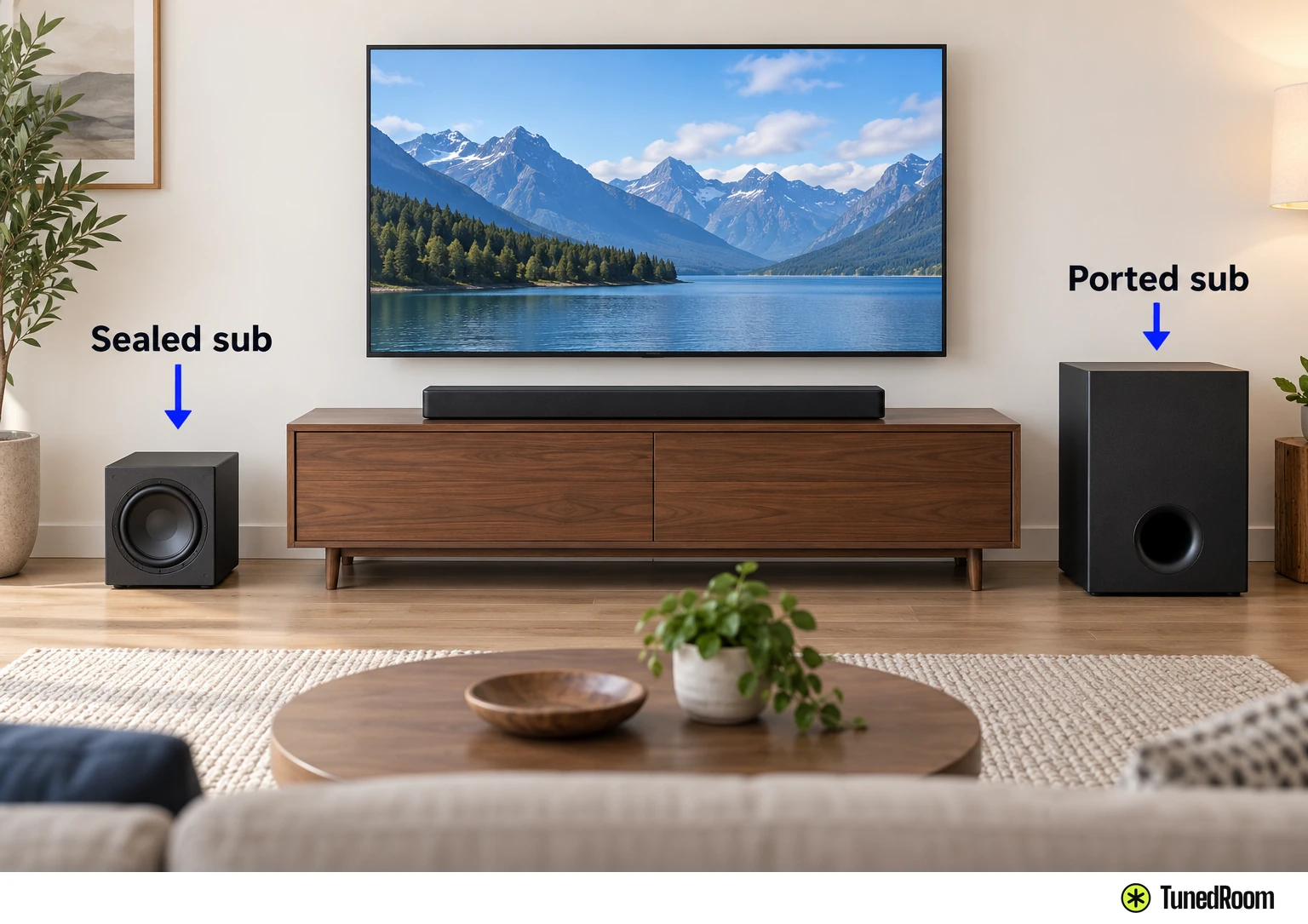
Run through these. The more that sound like you, the stronger the case for adding a sub.
- You want bass you can feel, not just hear.
- Music or bass-heavy movies make up a big share of what you play.
- You like to listen loud, or you watch action movies at reference volume.
- Your room is large or open plan.
Whether your soundbar can take a sub at all
This is the check that can end the search early. Some soundbars only have a proprietary output, and that makes connecting another maker's powered sub impossible.
What you want is a bar that accepts an RCA audio interconnect cable for its sub. A bar like that should work with almost any powered sub, and this subwoofer maker's checklist for soundbar subs (opens in a new tab) covers the other points worth weighing.
| What your bar has | What it means | Next step |
|---|---|---|
| A built-in or integrated sub | You're already getting bass from the bar itself | Decide whether you want more, based on what you play and your room |
| A separate sub that came in the box | It's from the same maker, which is the preferred kind of pairing | Judge it by ear before buying anything else |
| A connection that takes an RCA sub cable | Should work with almost any powered sub | Audition subs you like with your own bar |
| Only a proprietary output | Other makers' powered subs can't connect | Stick to subs your bar's maker lists as compatible |
Even with a working connection, aim for a bar and sub that are compatible designs, ideally from the same maker or from makers that explicitly say they work together. Matching brand names alone doesn't prove your exact pair works, so confirm the pairing is listed as compatible before you pay.
Hear a compatible sub with your own bar first
Subs differ in sonic signature and tonal character, so the verdict that counts is whether one sounds good to you with your own system. That's true even if your bar has no built-in woofer at all. These tips on matching a sub to your soundbar (opens in a new tab) add a few more points to compare.
- Pick a sub you've already confirmed is compatible with your bar, so whatever you hear is a pairing you could actually take home.
- Play it with your own soundbar, using the music and movies you actually watch and listen to, and notice whether you hear low sounds the bar couldn't produce on its own.
- Listen for blend. Each note should sound clean with no overhang, and the sub should sit in with the bar without calling attention to itself or taking over the soundstage.
- Weigh what you heard. Cleaner bass and a more immersive experience mean the sub is earning its place, and if you can barely tell the difference, your bar alone already suits you.
If your bar came with its own sub, give it the same ear test. Some bundled subs come across as one-note bass boxes that muddy the sound and distort easily, and if yours does, the connection check above tells you what a replacement can be.
Skip it, add one, or go bigger
Keep the bar on its own if the bass you hear now is enough, your room is modest and you rarely play loud. You're already getting bass, and a sub mostly adds depth and impact you've decided you can live without.
Add a modest sub if music and action movies are a big part of what you play and the audition made them sound cleaner and more immersive.
Go bigger if your room is large and open or you love reference-level movie nights, so the bass has enough muscle to reach your seat. Once you've picked one, our guide to placing a subwoofer with a soundbar helps you settle it into the room.
More in this category
Encore
Where to Place a Subwoofer With a Soundbar
How to Reset a Samsung Soundbar
How to Connect a Soundbar to a PC or Laptop
- Samsung Sound Bar Subwoofer Won't Link? How to Pair It Again
- How to Connect Speakers to a TV
- TCL TV Light Blinking? What It Can Mean and What to Try
- TV Will Not Come On? What to Do Before Calling Service
- Vizio TV Input Troubleshooting for No Signal and Missing Inputs
- How to Improve Your TV Sound
- Why Is My Record Player Not Spinning?