Two controls can mean two different jobs
- On an AV receiver, 80 Hz is a common starting point for the speaker crossover.
- Let the receiver manage that handoff. Set the connected powered subwoofer’s low-pass filter to off or its highest setting.
- With full-range stereo speakers and no bass management, start the subwoofer’s low-pass filter at the speakers’ low-end -3 dB point.
You may be looking at a receiver setting and a control on the subwoofer, both marked with frequencies. We’d identify which device manages bass before changing either one, because a receiver redirects bass from the speaker channels while a full-range stereo feed calls for the subwoofer’s own filter.
Once you’ve found the control that applies, check what your main speakers can reproduce at the low end. That capability gives the starting number meaning: a useful crossover lets the speakers ease out of the bass while the subwoofer takes over.
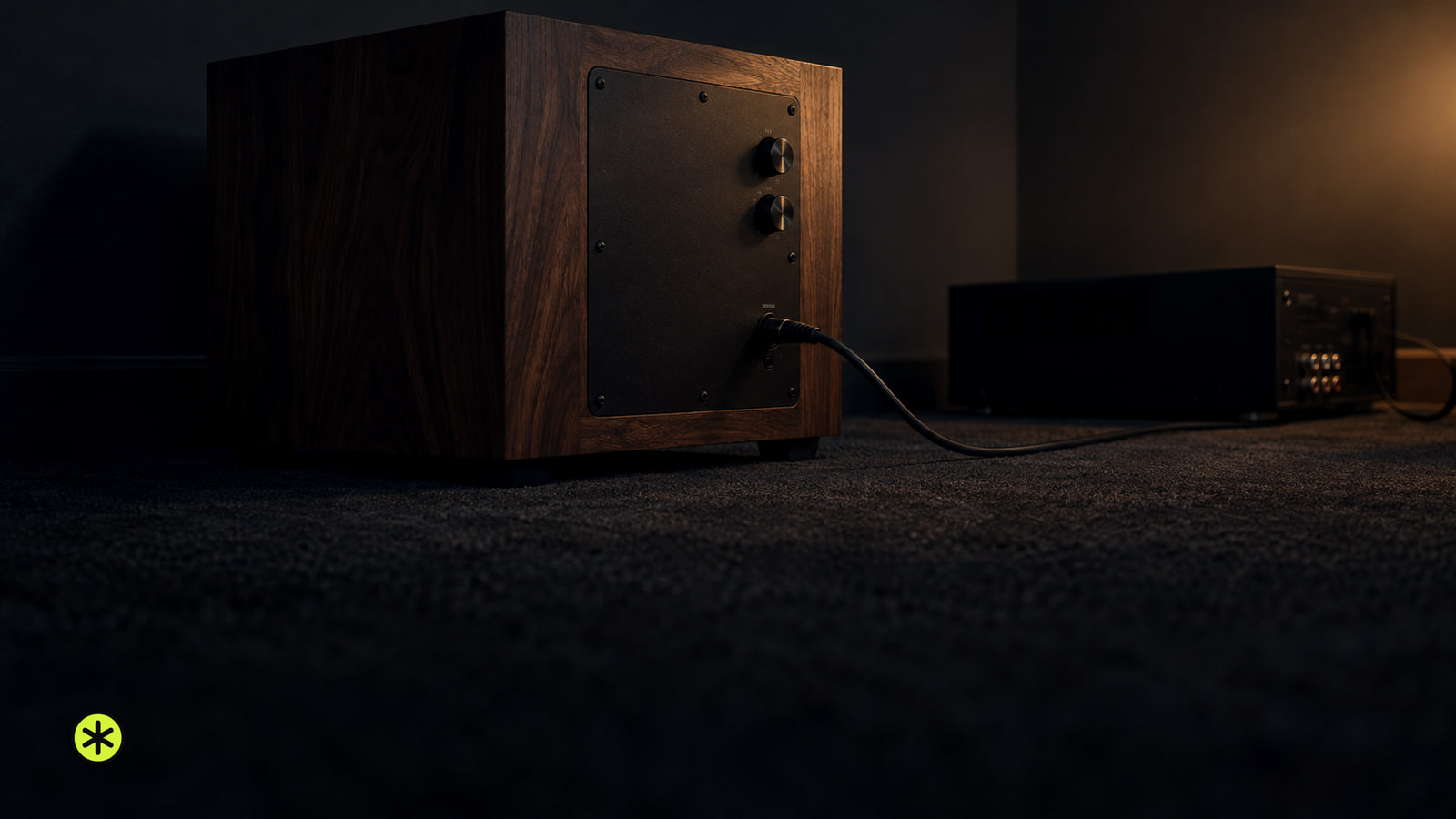
The handoff spreads across a range
A crossover describes a transition, not a sudden stop at the number on the dial. A high-pass filter sends higher frequencies toward a speaker and reduces the lower ones. A low-pass filter does the reverse for the subwoofer, reducing output above its setting.
Those reductions happen gradually. If a low-pass filter reads 80 Hz, the subwoofer’s output above 80 Hz fades rather than vanishing at that exact point. The speaker and subwoofer filters have to complement each other across the transition, where either too much or too little output can make the blend harder to get right.
That’s why a crossover number is a starting point for listening, even when it comes from a speaker specification. The speakers, the subwoofer and your room all affect how the handoff sounds at your seat.
Use the control that matches your signal path
Follow the signal path to decide which frequency control to use. The receiver route here assumes a powered subwoofer already connected from a dedicated subwoofer or LFE output to the subwoofer’s input, in the place where you’ll keep it.
| Your setup | Where to set the handoff |
|---|---|
| AV receiver or processor with a dedicated subwoofer or LFE output feeding a powered subwoofer | Set speaker crossovers in the receiver or processor. Turn the subwoofer’s low-pass filter off or to its highest frequency. |
| Stereo system without bass management, with main speakers receiving a full-range signal | Use the subwoofer’s internal low-pass filter. Start at the main speakers’ low-end -3 dB extension. |
On the receiver route, bass management filters low-frequency content from the speaker channels and redirects it to the subwoofer channel. If the subwoofer has a rotary low-pass control, its highest position may be marked LFE; a digital low-pass control can be disabled. The speaker crossover remains the setting you choose in the receiver.
On the full-range stereo route, the main speakers keep receiving the full signal. There’s no receiver bass management doing that handoff, so the subwoofer’s low-pass control supplies the starting cutoff. Keep the two routes separate when you read a frequency on the sub and another in an equipment menu.
Let each speaker’s bass capability guide the number
For an AV receiver, 80 Hz is a commonly recommended crossover, but the individual speakers determine whether you move away from it. Look up each speaker’s rated low-frequency extension in its specifications. One general guideline is to set that speaker’s crossover 10 to 15 Hz above the rating so its output can roll off into the subwoofer’s range.
For instance, a speaker specified to extend to 50 Hz at -3 dB leads to a 60 to 65 Hz crossover under that guideline. Another guideline starts roughly 10 Hz above the lowest frequency the speaker can handle cleanly. “Rated extension” and “lowest clean output” are different reference points, so use the one you actually have when you choose a starting setting.
Broad speaker categories can help you spot when 80 Hz deserves a closer look. Published starting ranges put compact on-wall or satellite speakers at 150 to 200 Hz, small center, surround or bookshelf speakers at 100 to 120 Hz, and mid-size versions at 80 to 100 Hz. Larger center, surround and bookshelf speakers are listed at 60 to 80 Hz, with very large versions at 40 to 60 Hz. Check each speaker’s own capability before applying a category range.
If your front, center and surround speakers have different low-end capabilities, consider each speaker’s extension when choosing its crossover. The goal is a handoff suited to the speaker carrying that channel, followed by a listening check with the subwoofer playing.
Your receiver may have chosen values already
If your receiver has already assigned crossovers through automatic setup, leaving those settings in place is one generally recommended approach. Existing room calibration also gives you a starting point before fine-tuning by ear.
SVS gives a different fine-tuning approach for an AV receiver: review whether automatic setup marked any main speaker Large, set all main speakers to Small, then set a crossover for each one from its measured or specified low-frequency extension. In that approach, Small redirects low frequencies from the main channels to the subwoofer. Set the speakers to Small before entering those individual crossover values.
These are distinct choices. You can keep the receiver’s assigned values while you listen, or deliberately review the speaker settings and use the extension guideline for each channel. The crossover recommendations give you a way to evaluate either result by how smoothly the speakers and subwoofer join, without treating 80 Hz as a required value for every channel.
Full-range stereo speakers need the subwoofer’s filter
When a stereo system has no bass management and its main speakers receive a full-range signal, begin with the speakers’ low-end -3 dB extension. Look for that figure in the speaker maker’s specifications or product manual. That number, rather than the AV receiver’s 80 Hz starting recommendation, is the initial setting for the subwoofer’s internal low-pass filter on this signal path.
For example, if the main speakers extend to 45 Hz at -3 dB, start the subwoofer’s low-pass filter at 45 Hz. Play music you know and adjust the subwoofer’s level by ear until its bass joins the main speakers without dominating them.
You can nudge the low-pass setting upward if you want to hear how a little more overlap sounds. Listen after the change, keeping the main speakers’ full-range feed in mind.
Listen for bass that joins the speakers
Listen where you normally sit, with the speakers and subwoofer playing together. You’re aiming for low notes that move smoothly between them, without the subwoofer drawing your attention to its location. Treat the chosen frequency as a starting setting and let that blend guide any further adjustment.
If you hear a bump around the crossover, adjust the subwoofer’s level to better match the main speakers. For the full-range stereo setup, familiar music makes it easier to judge whether the sub adds to the speakers or takes over. Leave the setting where the bass sounds joined and balanced from your seat.
More in this category