Match the output to the input
- Check your receiver’s output labels and your subwoofer’s input type before choosing a cable.
- A dedicated subwoofer output typically uses an RCA-type line-level connection. A speaker-output route needs compatible speaker-level inputs.
- For the Kicker 51MW, follow the amplifier-terminal and audio-lead wiring example below.
If you’re looking at an RCA socket on one box and speaker-wire connections on another, we'd identify the signal type first, because those connections serve different routes. We’d choose the dedicated receiver output first when your sub has the matching line-level input, because that route also lets a receiver with crossover adjustment control the filtering.
Read both ends of the proposed connection together. The receiver’s output tells you where the signal starts, while the subwoofer’s input determines which route you can use. KEF’s connection guidance across brands (opens in a new tab) covers dedicated line-level outputs and compatible speaker-level alternatives.
Your receiver has a dedicated bass output
Look for an output marked Subwoofer or LFE on your receiver. KEF distinguishes these two labels: both concern bass sent to the subwoofer, but the signals and terms aren’t interchangeable. A subwoofer output is a line-level connection that typically uses an RCA-type connector.
For that route, run the RCA-type connection from the receiver’s subwoofer output to the subwoofer’s line-level input. An LFE output typically has a single connector, and KEF applies the same connector guidance (opens in a new tab) to it. The choice between one or two inputs on the sub is covered next.
The distinction matters when you choose the receiver settings. In a Dolby or DTS mix, the subwoofer output can contain bass from up to all six channels, with the receiver’s bass management deciding what’s included. That can include bass from the front channels when those speakers can’t reproduce those frequencies.
The LFE channel carries additional bass information created for movie and soundtrack playback, supplementing the bass going to the main channels. That’s why identifying the output is more useful than treating every bass-related socket as the same signal.
One receiver socket and two subwoofer inputs
Count the connectors at each end. For a receiver with one output connector and a subwoofer with two inputs, KEF advises using the left input. It also recommends an RCA Y-adapter feeding both left and right inputs, because some subwoofers play at only half volume or enter standby more frequently when fed through one side.
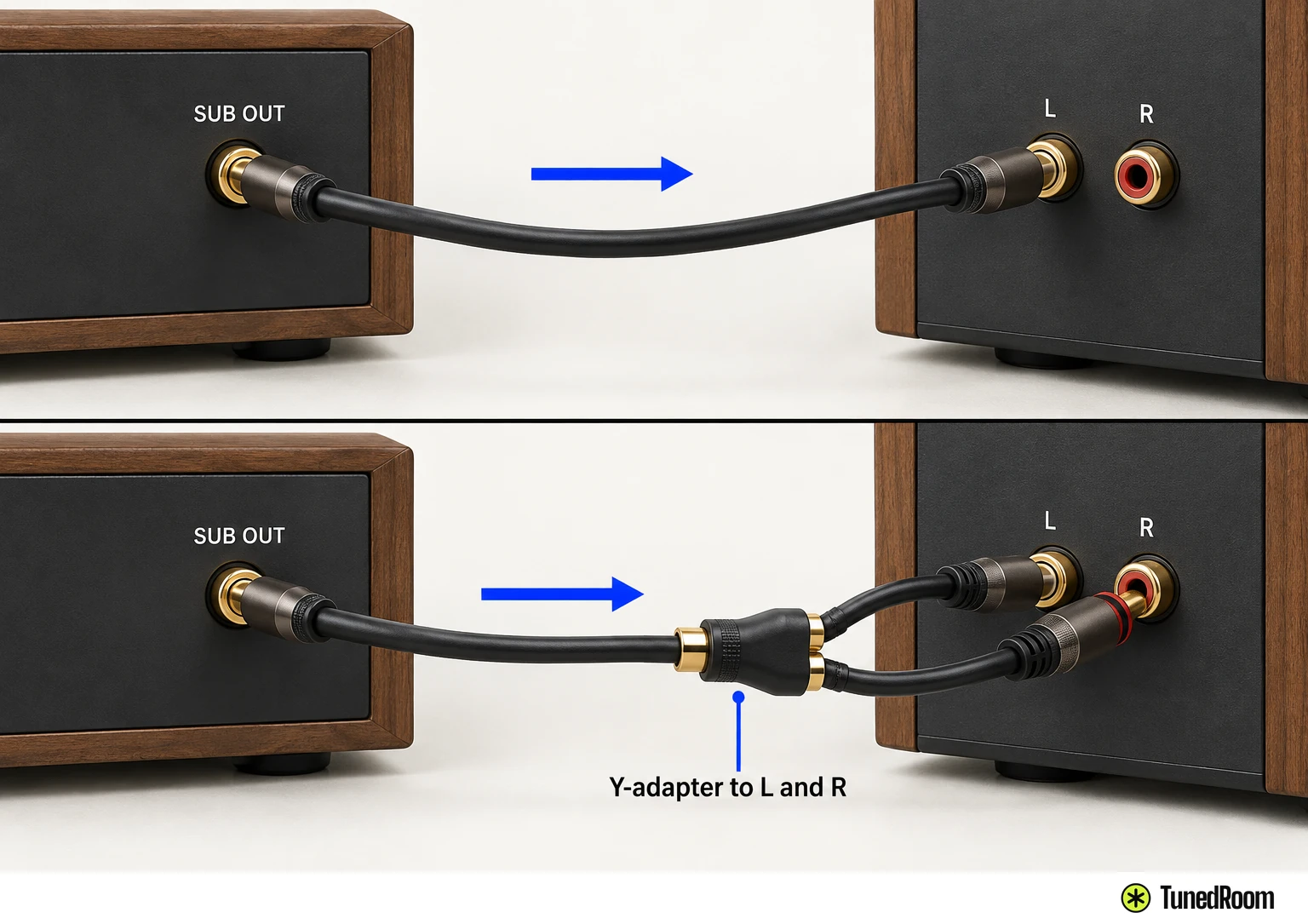
That makes the subwoofer’s input design part of your cable choice. KEF’s single-output and two-input advice (opens in a new tab) describes both a usable single-input route and the reason to feed both inputs on affected subs.
There’s a named exception for KEF SmartConnect subwoofers Kube, KF92 and KC62. KEF says their circuitry compensates for a connection through one input, giving the expected output with either one or two connectors. That exception belongs to those named SmartConnect products.
Give the crossover a clear job
Find out whether the receiver sends a full-band signal or filters it before it leaves the subwoofer output. With a full-band output, the subwoofer’s crossover filters out the high frequencies. A receiver with a built-in low-pass filter can do that filtering before sending the signal down the cable.
When your receiver lets you adjust the crossover frequency, set the crossover at the receiver and turn the subwoofer crossover as high as it goes (opens in a new tab). This lets the receiver’s crossover work without interference from the subwoofer’s crossover.
The practical choice is where the filtering happens. Use the subwoofer’s crossover for the full-band route, or give control to the receiver when it provides crossover adjustment. Keep this setting choice tied to the connection you’re making, since the speaker-level pass-through route below uses a different arrangement.
Your receiver has no dedicated subwoofer output
Check for speaker-level inputs on the subwoofer before using the receiver’s speaker outputs. Those inputs are the prerequisite for KEF’s fallback when a receiver lacks a dedicated subwoofer output. The next choice depends on whether the sub also has speaker-level outputs for your main speakers.
For a subwoofer without a secondary output to your speakers, use the receiver’s B or second speaker output to feed the sub’s speaker-level inputs. Before choosing this route, confirm that the receiver can operate A and B speakers simultaneously, because this arrangement needs both sets operating together.
For a subwoofer with both speaker-level inputs and speaker-level outputs, connect the receiver’s speaker outputs to the sub’s speaker-level inputs. Then connect the sub’s speaker-level outputs to your speakers. This gives you a receiver-to-subwoofer-to-speakers path.
In that input-and-output arrangement, set the receiver crossover to 20 Hz or off (opens in a new tab), because the subwoofer’s crossover acts as the system crossover for both the sub and the speakers. Choose between these two routes by the actual connections and A/B capability your equipment provides.
Kicker 51MW example and wire preparation
For the Kicker 51MW subwoofer, use the MW-family amplifier-and-audio-lead procedure. Its audio leads connect to the amplifier’s subwoofer output terminals, so this example uses a terminal connection with specified polarity.
Before running the cable, match the amplifier’s supported load to your MW subwoofer. The MW family is rated at 2 ohms or 4 ohms, and Kicker requires an amplifier designed for the applicable 2- or 4-ohm operation. Kicker recommends 12-gauge or larger wire for this connection.
Plan the route clear of standing water and moving boat components. Keep the wire away from sharp edges and places where it could get pinched. These Kicker wiring precautions (opens in a new tab) belong to the cable run itself, before you attach the audio leads.
Use an accessible factory hole and grommet where available. If there isn’t one, or it’s inaccessible, Kicker instructs you to drill a hole for the wire. Avoid existing wiring and mechanisms while drilling, and fit a rubber or plastic grommet wherever the wire passes through a hole to protect the wire and boat from damage.
Kicker 51MW audio leads and plugs
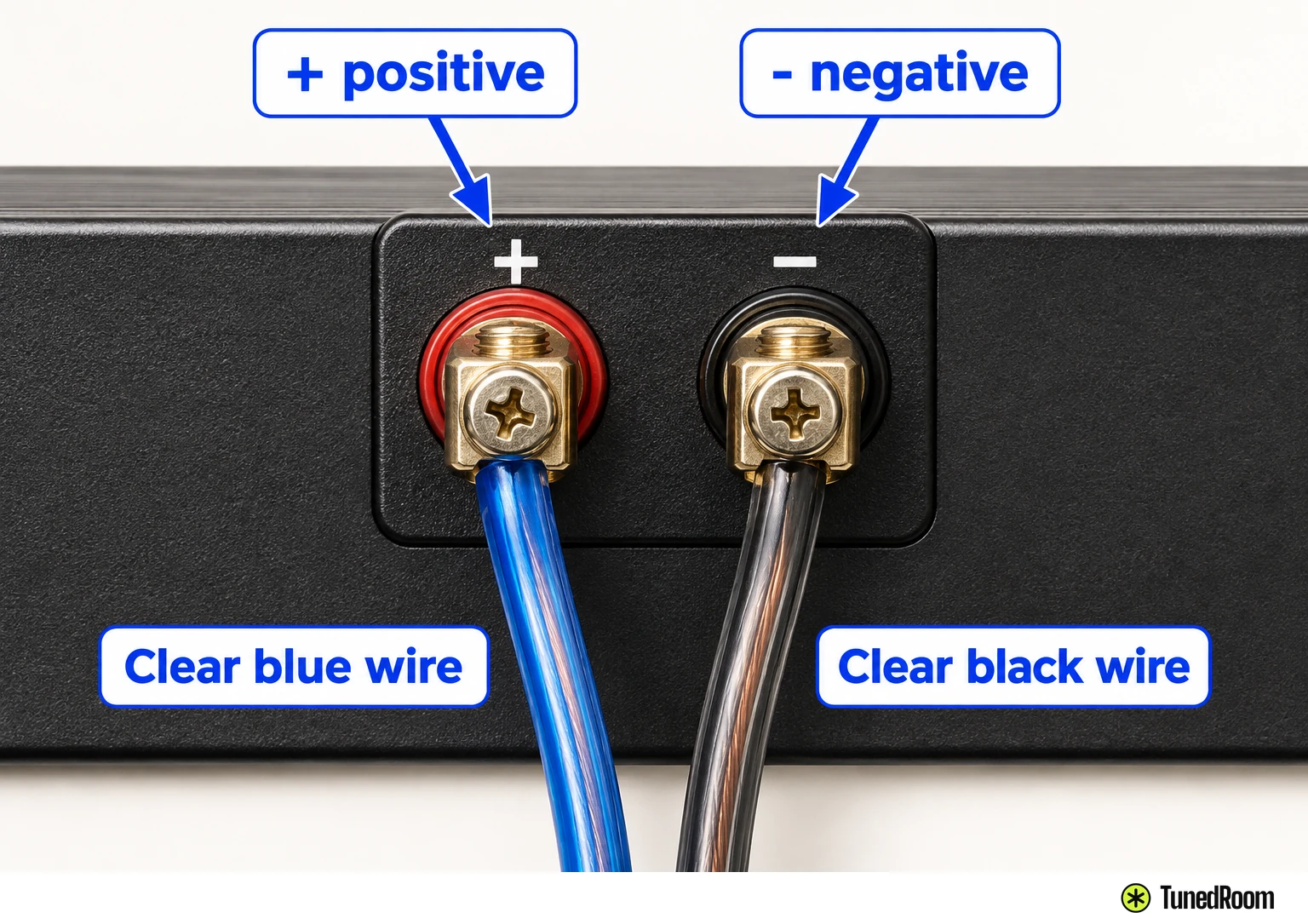
Identify the clear blue and clear black audio leads before attaching them. The MW audio connection (opens in a new tab) assigns a specific amplifier-terminal polarity to each one.
- Connect the clear blue audio wire to the amplifier’s positive (+) subwoofer output terminal, with the blue lead at +.
- Connect the clear black audio wire to the amplifier’s negative (-) subwoofer output terminal, with the black lead at -.
- Connect the MW audio and LED plugs to the MW, completing the plug connection at the subwoofer.
Leave clearance and control the volume
Before using the connected Kicker system, allow for the amplifier’s ventilation requirement of up to 4 inches (10 cm) of open space. Keep at least 1 inch (2.5 cm) between the front of the subwoofer and any surface. Those clearances are conditions of the connected installation.
Avoid prolonged operation with distortion, clipping or excessive power. Kicker warns that this can overheat the system, potentially cause a fire and seriously damage components or the vehicle. Keep these operating limits (opens in a new tab) in mind as you bring the volume up.
More in this category