What each one does with the bass
- A woofer handles bass within a main speaker and may also cover midrange. A subwoofer specializes in deeper bass alongside your main speakers.
- Keep your current setup if you like its bass. Consider a subwoofer when you want low notes your speakers don’t deliver or more weight from film effects.
- Before choosing one, compare bass reach and the output you want, then check whether it needs its own amplifier.
If you’re weighing another box for a system you already enjoy, we’d listen at your usual level before shopping, because extra bass only earns its place when you want what your speakers aren’t giving you.
In a two-way speaker, the tweeter handles high sounds while the woofer covers midrange and bass. Add a separate midrange driver, and the woofer can focus more on bass while still meeting that driver’s range. Either way, it works with the other drivers in your main speaker.
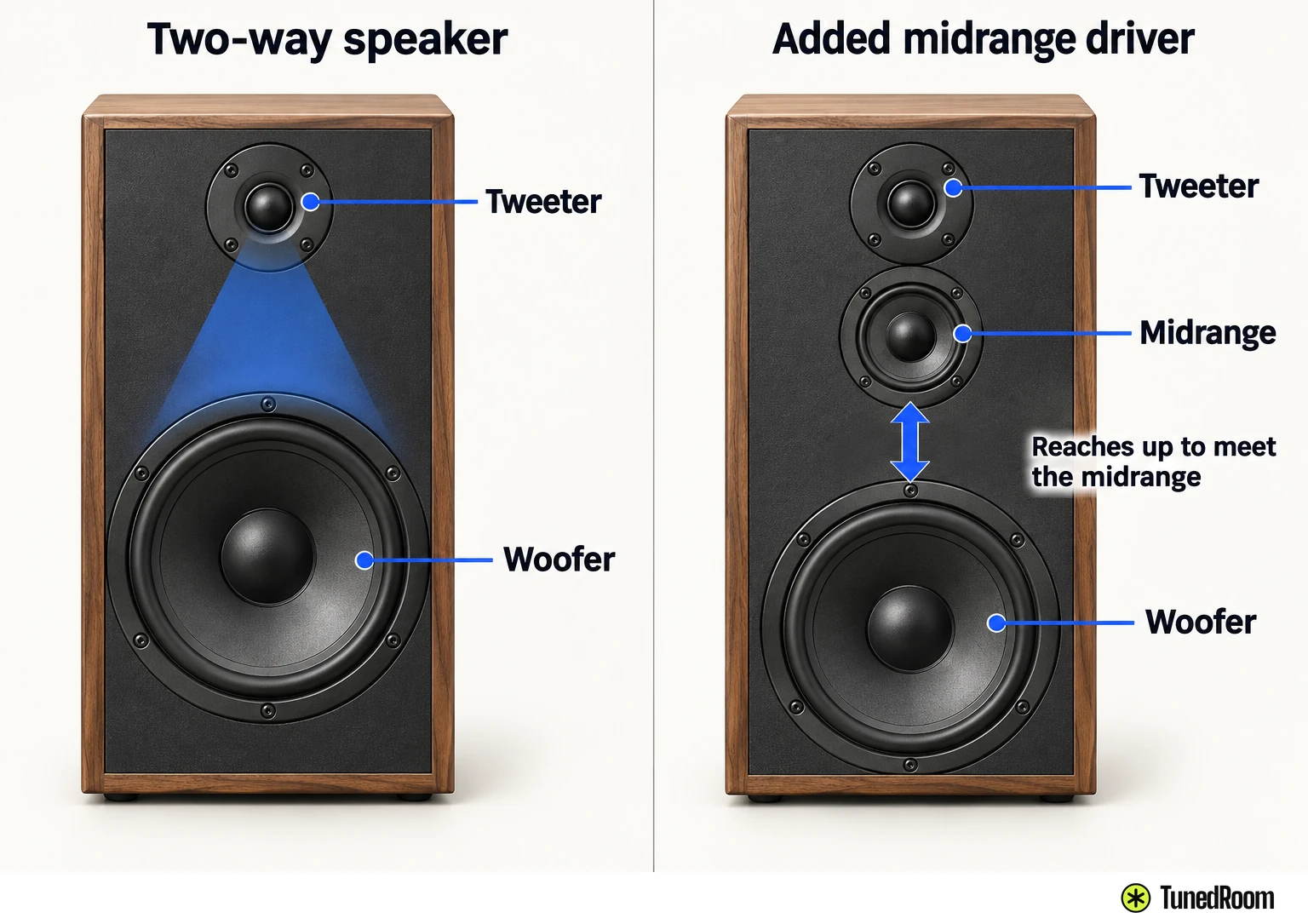
A subwoofer focuses on low bass; it complements the main speakers instead of taking over their whole job. The names overlap: a separate bass speaker may also be called a woofer, and some large main-speaker woofers reach notes that dedicated subwoofers cover. Compare what each speaker does in your system instead of treating one frequency as the dividing line.
When your speakers are already enough
Play music or a film you know at the level you enjoy, from the place you normally listen. Pay attention to whether you want more depth or weight in the low notes. If the balance already suits you, your speakers can stay as they are.
Speaker size helps explain the choice, but it doesn’t settle it. Small bookshelf speakers may leave more low bass for a subwoofer to add, while a well-matched subwoofer can add deeper or louder bass even alongside larger speakers. Some large woofers already reach into the range a subwoofer covers.
There’s also such a thing as too much bass for your taste or room. Very large floorstanders in a small room may already give you plenty; adding a subwoofer there can contribute little you want or make the sound feel overwhelming.
What changes with music and movies
For stereo music, let the tracks you play guide the decision. Pipe organ and electronic music can reach very low, while much other music has little content below 30 Hz. A subwoofer has more to offer when that deeper material matters to you.
For films, a surround mix such as 5.1 can give the subwoofer two jobs: playing deep bass routed away from the main speakers and reproducing the dedicated low-frequency-effects channel. That channel carries rumbles such as thunder and explosions.
If a home cinema amplifier routes the lowest frequencies to a subwoofer, the main speakers have less deep-bass work to do. Most stereo amplifiers lack that bass management, so make the stereo decision around the additional bass you want to hear, rather than expecting the main speakers’ workload to change.
Compare the bass you have with the bass you want
Find the lower frequency limit of your main speakers and compare it with each candidate subwoofer’s low-frequency response. Look for an extension below what your speakers already provide. As a rule of thumb, speakers reaching 50 Hz could pair with a subwoofer reaching about 30 to 35 Hz; floorstanders reaching 35 Hz make a stronger case for a subwoofer that goes below 30 Hz.
Some subwoofers reach around 30 to 35 Hz, and home designs can reach lower. Choose that extra depth when your music or films give it a job. Along with reach, the goal is bass that stays accurate, loud and clean enough at the level you prefer.
Count the space beyond your listening room
Include adjoining spaces when you judge how much subwoofer output you want. A listening room with large openings asks the subwoofer to serve more space than the room alone suggests. In general, a larger space may call for a larger subwoofer to reach the level you enjoy.
Check what powers the subwoofer
Check whether a candidate is active or passive before you choose it. An active, or powered, subwoofer has an amplifier built in, so it doesn’t draw its driving power from the amplifier for your main speakers. It needs mains power and may have its own output control.
A passive subwoofer needs external amplification. If it has no built-in gain, phase or crossover controls, an external device such as an audio/video receiver or digital signal processor must provide those controls. Include that equipment in your choice.
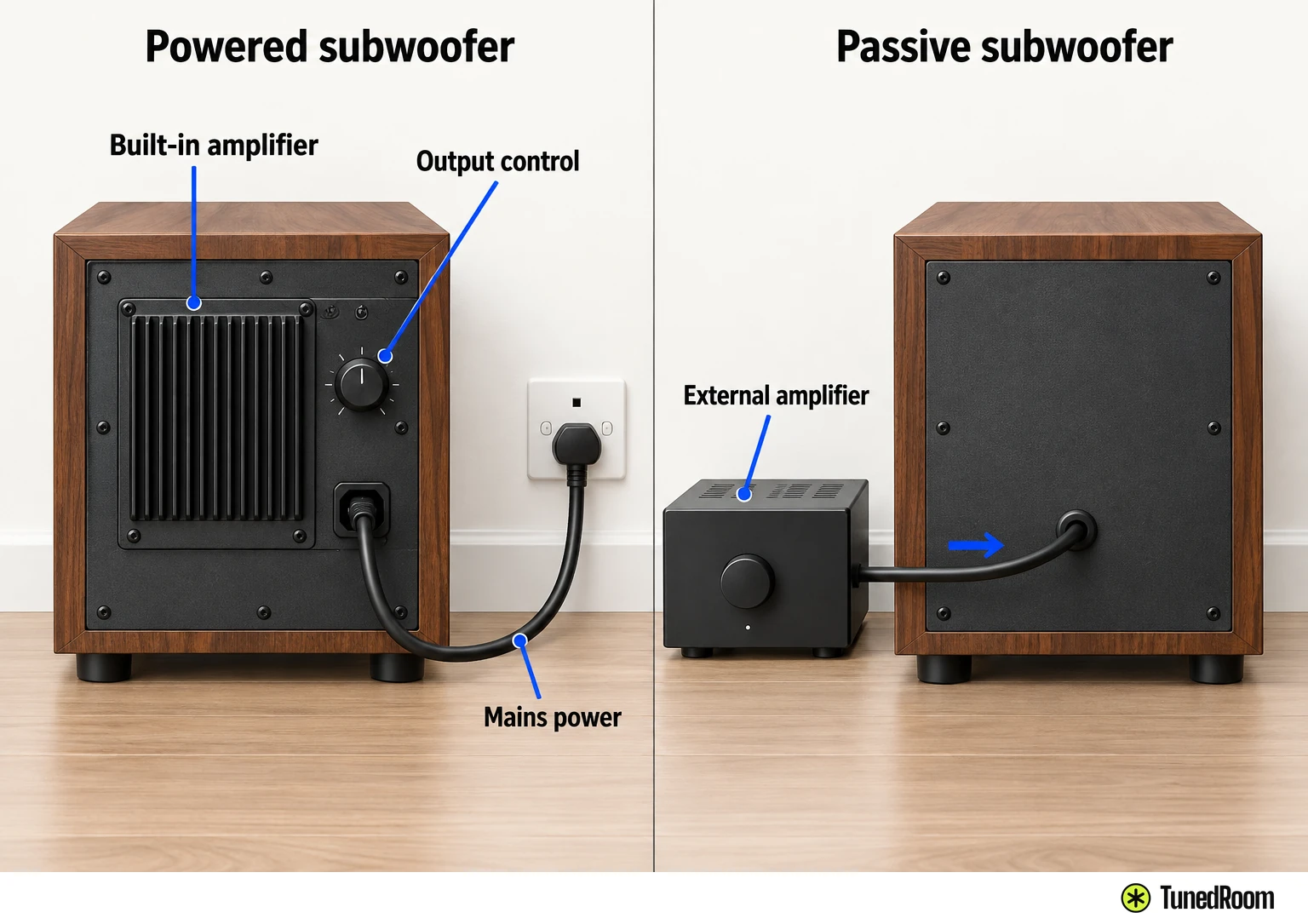
Settle on a candidate that extends the bass you want for your listening material and room, then check its power and control requirements against the equipment you have. That leaves you with a choice based on the bass it can add and what you’ll need to run it.
More in this category