Give voices a place at the screen
- Keep your center speaker close to the screen, aimed toward your main listening seat.
- On furniture, start by checking whether the speaker lines up with the front edge.
- A cabinet top or shelf can work. If a large center won't fit your AV furniture, consider an ear-level stand below the screen.
- Behind-screen placement is an option with a projector and an acoustically transparent projection screen.
If your SVS center already sits on the TV cabinet, we'd check its front-to-back position before choosing another home for it. SVS links furniture-edge alignment to clarity and dynamics, which makes it a useful first adjustment without changing the whole arrangement.
Think of placement as three decisions with different reference points. The screen determines where you want voices to seem to come from, the furniture's edge determines the speaker's position on that surface, and your listening seat determines where it should aim. Getting one right still leaves the other two to check.
There's good reason to give this speaker some attention. SVS says nearly 70% of all audio playback comes through the center channel at any given moment, and that it handles the majority of vocals and dialogue in music and movies. Its placement also helps connect effects across the front speakers.
Above or below works with the right aim
For a TV, consider the top of your entertainment cabinet or a shelf above or below the picture. SVS's placement guidance supports all three (opens in a new tab). Include the direction the speaker will face in that choice, because a shelf position needs an upward or downward angle toward the listener.
Keep the center as close to the screen as possible, whichever location you choose. That instruction applies both in front of the screen and behind it. A position that puts the speaker near the picture serves the goal of making voices feel attached to the people you're watching.
Above versus below is therefore a choice to make alongside the aiming question. For your SVS center, either shelf position is an option when you can direct the speaker toward the listening position. Look at the available location from your seat as well as from beside the TV, so you're considering both where the cabinet sits and where its drivers face.
Line up the speaker with the furniture edge
Bring a speaker resting on furniture forward until its front is flush with the furniture's front edge. The visible result is a shared front line between the speaker and its supporting surface. Use that line as your reference when checking a center that's been sitting farther back on the cabinet.
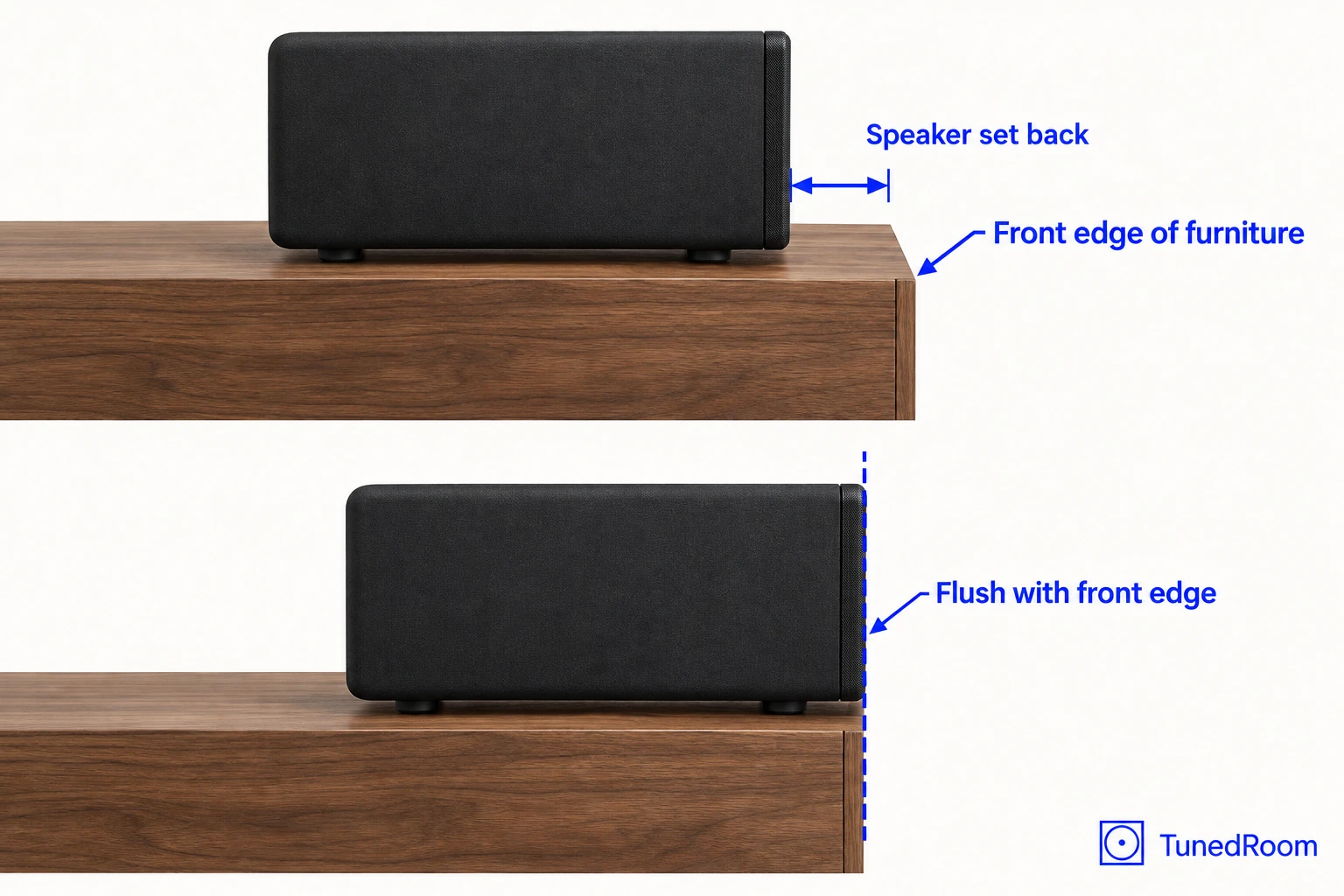
SVS recommends flush alignment (opens in a new tab) to eliminate lobing of the sound waves that can hurt clarity and dynamics. Lobing concerns uneven sound distribution, so this is an acoustic placement choice as well as a question of how the speaker looks on the furniture.
That distinction helps when you're deciding what to change. A speaker can occupy the right general area near the TV while its position on the supporting surface still needs attention. Here, you're addressing the way it presents sound into the room, with even coverage of the listening area as the broader goal.
A large center can go on a stand
When a large center won't fit in your AV furniture, consider a stand below the screen. SVS recommends ear-level placement for this arrangement (opens in a new tab). It gives you another place for the existing speaker when the furniture's available space is the obstacle.
Evaluate the position the speaker will occupy once it's on the stand. The useful height is the speaker's listening height, rather than the height of the stand by itself. Your seated ear level is the reference, with the center below the picture.
This makes the stand decision fairly specific. If the cabinet top or a shelf accommodates your center, those remain placement options. If the speaker's size rules out the AV furniture, the stand provides a separate route to the intended position without making the speaker fit that furniture.
Behind the screen requires the right screen
With a projector and an acoustically transparent projection screen, place the center behind the screen at ear height. SVS describes this combination as ideal placement. It lets the speaker occupy the area of the projected picture, directly serving the goal of locating voices at the screen.
Check the screen type before choosing this route. The behind-screen recommendation requires an acoustically transparent projection screen (opens in a new tab) used with a projector. Having a projection system is only part of that combination, so the screen's suitability belongs in the placement decision.
For this arrangement, work from the ear height at your listening seat when choosing the speaker's vertical position. That's a different physical arrangement from fitting a center above or below a TV, where the shelf location and the speaker's angle have to work together.
Your seated ears set the angle
Use ear level at your main listening position as the target for the speaker's angle. If the speaker sits below that target, aim it upward. If it sits above the target, aim it downward, so the direction follows the listener's position instead of simply following the shelf.
For upward tilt, put rubber doorstops or other non-abrasive wedge-shaped objects below the speaker's front edges. Choose non-abrasive wedges for this contact with the speaker. Lifting the front elevates the tweeter and other drivers toward the listening area, which is the purpose of this adjustment.
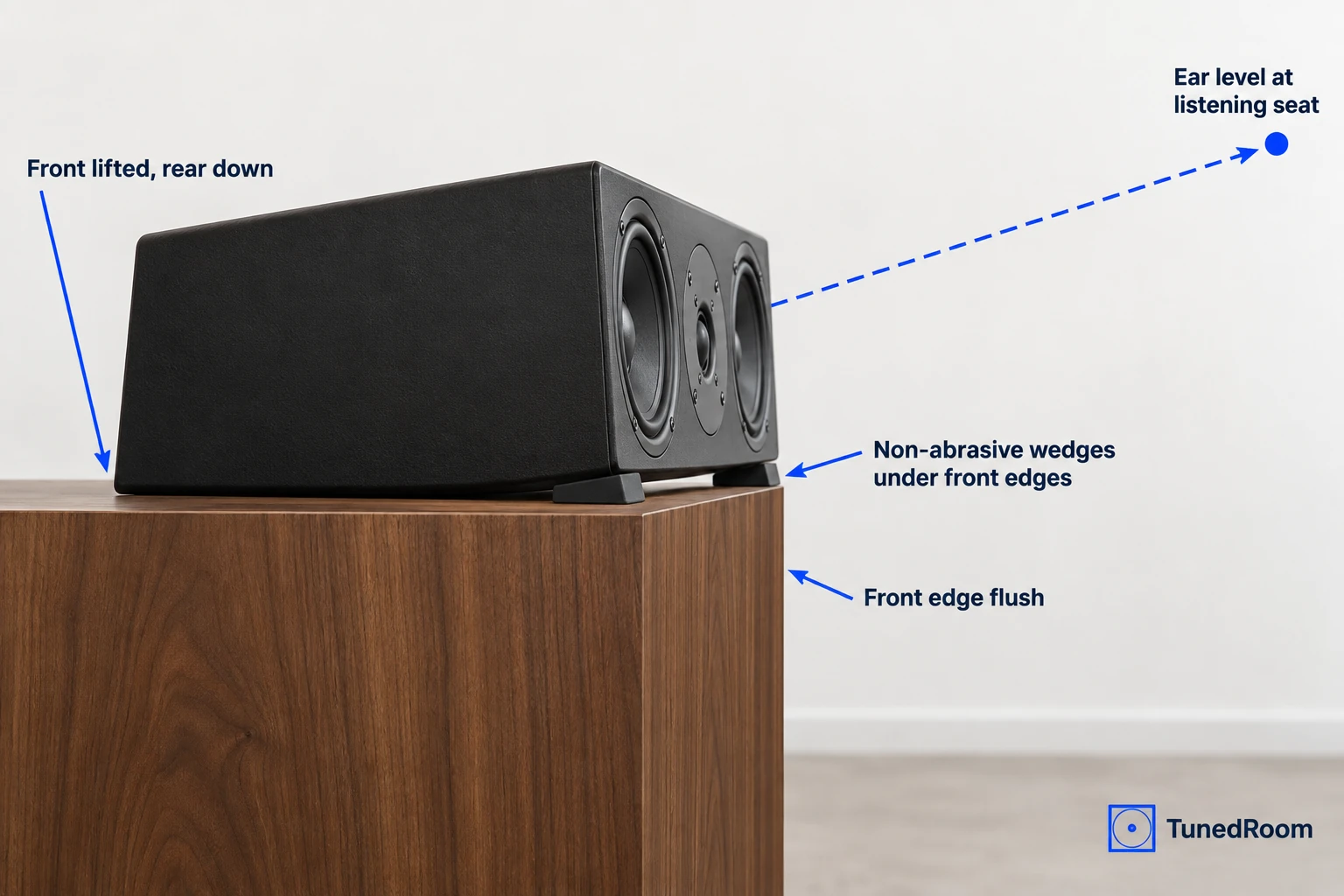
For an optional aiming check, hold a laser pointer against the top of the center speaker (opens in a new tab) to check its direction toward ear level at the main listening position. This gives you a reference for the angle whether the speaker is above or below the screen.
Listen for connected voices and effects
From your listening seat, pay attention to where dialogue seems to originate. The intended result is voices that feel attached to the picture. Also listen to effects moving from left to right across the front speakers, where proper center placement should support a continuous path through the middle.
Consider the listening area as well as the main seat. SVS warns that uneven presentation of sound across that area can seriously compromise the experience. As you listen from the places people sit, pay attention to consistency of presentation alongside the connection between the voices and the screen.
If you're unsure which location or angle suits your arrangement, contact SVS Sound Experts at custservice@svsound.com with your center-speaker setup or placement question. Describe the position you're considering so the question stays focused on the choice you need help making.
More in this category