A stereo amp powers two speakers
- A stereo amplifier boosts an audio signal so it can drive two channels, left and right.
- In hi-fi, it's typically an integrated amp: one box that picks the source, sets the volume and powers passive speakers.
- An AV receiver is a multichannel amplifier that adds a tuner, video handling and extra channels for surround sound.
- Powered speakers and powered soundbars already have an amp inside, so check yours before you buy anything.
Shop listings use "stereo amplifier," "integrated amp" and "AV receiver" as if you already know the difference, and it's easy to buy a box you never needed. We'd start with the speakers you already own, not the amp, because that one check decides whether you need a separate amp at all. Powered speakers make their own power, while passive ones can't play a note without an external amp.
Once that's settled, the rest comes down to how many channels you want to feed and whether you want one box handling video as well as sound.
What amplification actually does
At its most basic, an amplifier is an electronic device that raises the amplitude of an electrical signal, and its main job is reproducing sound. It can raise the signal's voltage, current or power.
Whatever you play from, whether that's a turntable, a laptop or a CD player, some form of amp has to sit in the chain. It lifts the signal's power to a level you can actually hear through speakers or headphones.
The amp then hands that boosted signal to the speakers. There it makes the speaker cone vibrate, and those vibrations become the sound waves you hear as music.
Every system needs amplification somewhere, but it isn't always a separate box. A lot of amps these days are built right into the speakers themselves, which is why the speaker check matters so much.
Why stereo amps are typically integrated amps
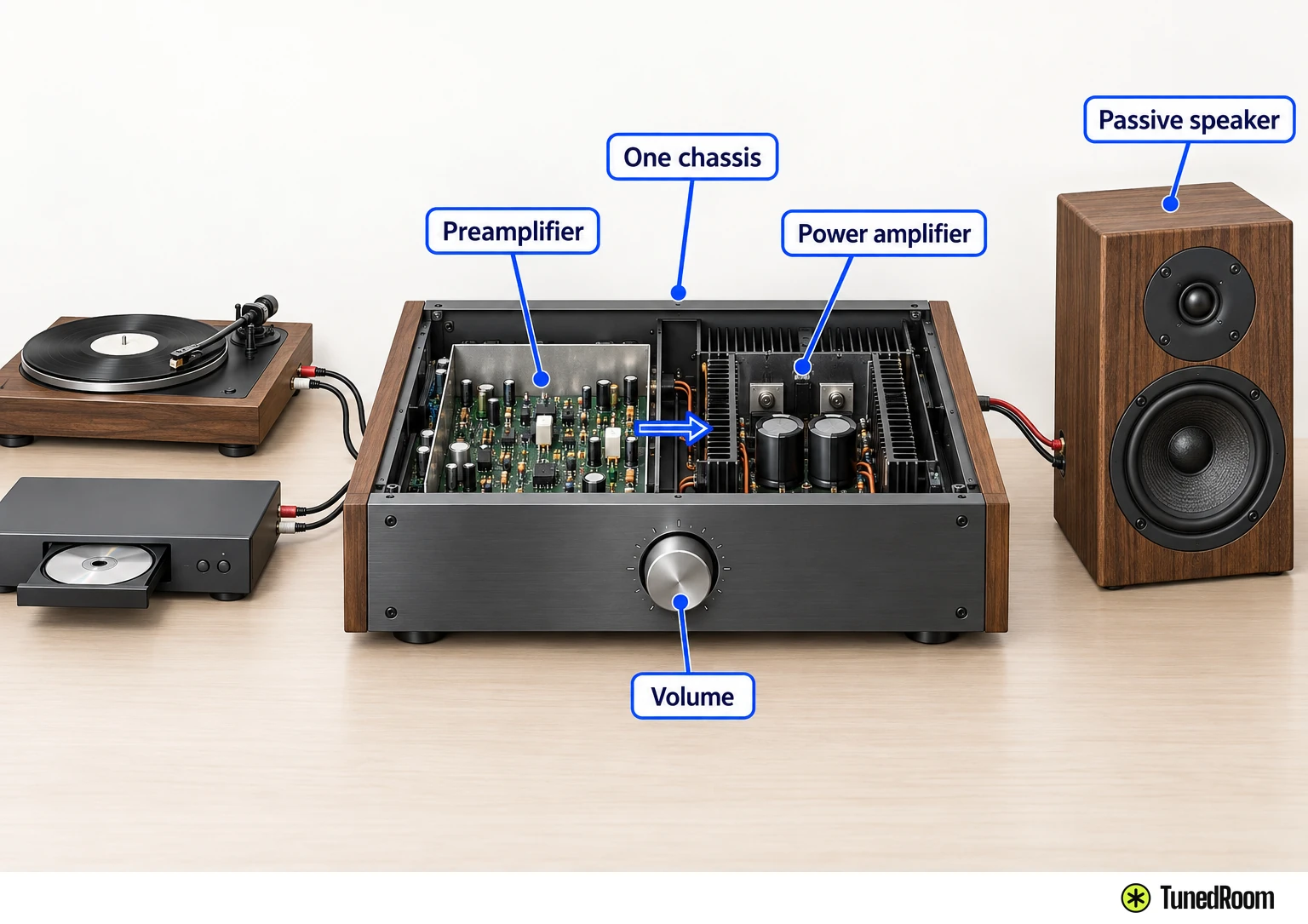
When people talk about hi-fi components, a "stereo amplifier" is typically an integrated amplifier. That's a preamp and a power amp combined in one unit, normally built for two-channel stereo.
Because both halves share a box, it does more than power speakers. It also lets you choose which source you're listening to and control the volume.
Expect inputs for gear like a turntable, CD player or network player. On the output side, it powers passive speakers, which lean on the amp because they have no power supply of their own.
The word "integrated" refers to the preamp and power amp living in one box. A Bluetooth or streaming badge is a separate feature, so when you compare models, look for one that handles source selection, volume and speaker power together.
Two channels versus a room full of speakers
Channel count is the cleanest dividing line. A stereo amp handles two channels, left and right.
The multichannel box most people run into is the AV receiver. It's an amplifier plus a built-in tuner, and it also processes video signals and routes them to the right display. Denon describes AV receivers as able to power anywhere from 5 to 15 channels, and those extra channels are what create surround sound.
Every receiver is technically an amplifier, but plenty of amplifiers aren't receivers. That's the mix-up the table below is meant to head off, since a powered speaker skips the separate amp entirely.
| Type | What it does | Channels | Fits when |
|---|---|---|---|
| Integrated stereo amplifier | Selects the source, controls volume and powers passive speakers | Two, left and right | You want to hear a turntable or other hi-fi gear |
| AV receiver | Amplifies, adds a built-in tuner, and processes and routes video to your display | 5 to 15, in Denon's description | You want one unit for both audio and video sources |
| Powered speakers or powered soundbar | Has its own built-in amplifier | Built in, no external amp needed | You want speakers that are ready to play out of the box |
Video jacks don't decide the label
It's tempting to glance at a back panel and call anything with video jacks an AV receiver. Older stereo amps show why that shortcut breaks down.
Yamaha's AX-2000 integrated amp arrived in 1987 with high-resolution D/A converters and video inputs. In 1990 the audio-only AX-2000A dropped the converters and the video inputs and outputs. If you like the backstory, Yamaha's integrated amp history (opens in a new tab) covers it.
Go by channel count and what the unit does with video instead. An AV receiver processes video and sends it on to your display, and that's the job to look for. A video input on an older two-channel amp like the AX-2000 doesn't turn it into a receiver.
Do your speakers need an amp at all?
Sort out which kind of speakers you have before you shop, because that tells you whether an external amp belongs in your system in the first place.
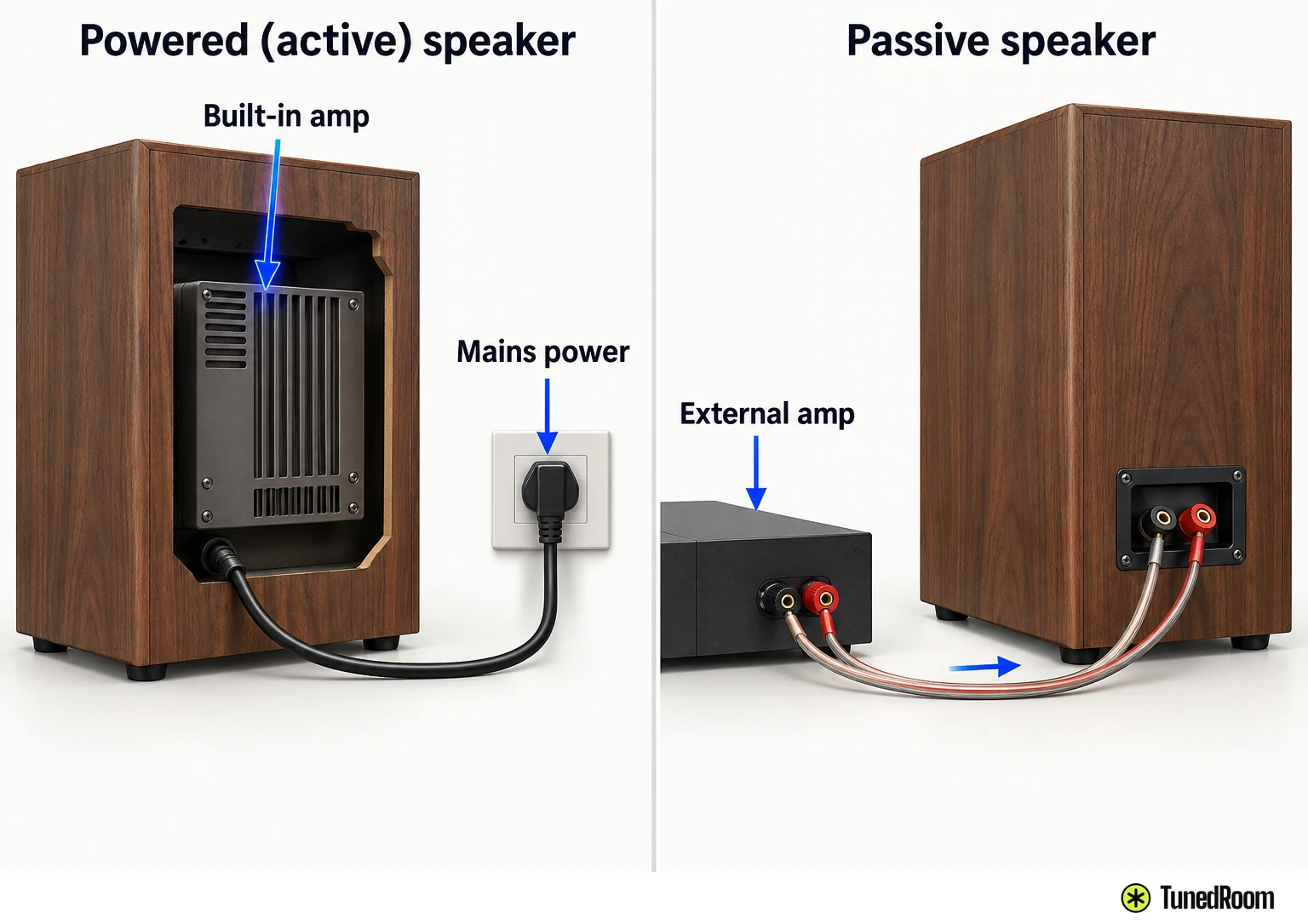
- Powered (active) speakers have a built-in amp and generate their own power, so they don't need an external one. Most Sonos speakers work this way.
- All-in-one speakers with their own built-in amplifier and power supply don't need an amp.
- A soundbar doesn't need an amp as long as it's an active, powered soundbar.
- Passive speakers have no built-in amplifier and need power from an external amp. In-wall and in-ceiling speakers are often passive.
If you're still unsure which kind you own, this explainer on active and passive speakers (opens in a new tab) lays out the difference. Passive speakers, with no power supply of their own, are exactly what an integrated stereo amp is built to drive.
Picking the box that fits your setup
With your speakers sorted, what you want the system to do decides the rest.
If you want a single unit that handles both audio and video sources, look at an AV receiver. If you just want to hear your turntable or other hi-fi gear through passive speakers, an integrated stereo amplifier is the simpler pick, and this amplifier buying guide (opens in a new tab) puts both categories side by side.
If your speakers are passive and you only want two of them, we'd keep it simple with an integrated stereo amp. It already covers source selection, volume and speaker power in one box.
The tuner, video processing and extra channels of an AV receiver earn their place once you want one unit running your video sources and a surround layout.
Last check before you buy: list every source you plan to use, whether that's a turntable, a CD player or a network player, and make sure the amp has an input for each one.
More in this category