Pick the route your speakers support
- Seeing both speakers in your Bluetooth list only means they're paired. Getting both to play takes one more step.
- Same-brand speakers? Link them with a feature both models support, such as Sony Party Connect, JBL PartyBoost or the Bose Shortcut button.
- On a Galaxy phone with Dual Audio, open Media output and tick both speakers.
- Want true left and right stereo? In the Sony, JBL and Bose examples here, that takes two of the same model.
- Watching video? Check that voices line up with the picture from your seat before you settle on a setup.
There are three Bluetooth routes to getting one source playing through several speakers: a phone or computer that sends sound to two outputs, speakers that link to each other, or an Auracast broadcast. If your speakers have their own linking feature, we'd start there, because in the Sony, JBL and Bose examples below, that's the route that offers stereo.
Decide whether you want sound in more places or separate left and right channels, because that changes which speakers qualify. Sony lets an SRS-XE200 and an SRS-XE300 share a Party Connect group, but its Stereo Pair needs two SRS-XE300s. For stereo, we'd plan on two of the same model, since every stereo mode below needs a matching pair.
Multipoint is a different feature. On the SRS-XE300, it connects two phones or other sources to one speaker, and the speaker plays music from one of them at a time.
Check the exact source and speaker models before you buy anything or reset a speaker. If your combination has no listed route, more pairing won't create one.
Link Sony speakers with Party Connect
The SRS-XE200 and SRS-XE300 can join the same Party Connect group (opens in a new tab). Check any other Sony speaker against the compatibility list, because Wireless Party Chain speakers can't join.
Update every speaker you're adding, put them all within 1 meter (3.2 feet) of each other, and stop playback. Then, for a group of SRS-XE300 speakers:
- Turn on the first SRS-XE300 and connect it to your phone or other source over Bluetooth.
- Hold the Bluetooth and volume + buttons together for about 2 seconds, until you hear the notification sound.
- Turn on the second XE300 and hold the same two buttons for about 2 seconds. It plays a notification sound and joins.
- Repeat for any other XE300s. Other compatible models can do this differently, so check that model's own steps.
- Start playback at a moderate volume and check that every speaker is playing.
Stop playback before you change the source, swap speakers or end the group. To end it, hold Bluetooth and volume + together on the first XE300 for about 5 seconds.
Need to pair the first XE300? Keep your phone within 1 meter, make sure the speaker is charged or plugged into a USB AC adaptor, and turn the volume down on both so nothing blasts out. Turn the speaker on and press the Bluetooth button if its light isn't already double-flashing, then pick SRS-XE300 on your phone (opens in a new tab), enter 0000 if it asks, and wait for “BLUETOOTH connected” and a steady light.
Make a stereo pair from two Sony XE300s
Stereo Pair (opens in a new tab) needs two SRS-XE300s. Update both, put them within 1 meter of each other, stop playback and turn the volume down on your phone and both speakers. Adding a speaker that's already in another group takes it out of that group.
Open Sony | Music Center, and on an iPhone with iOS 13 or later, allow Bluetooth access under Settings > Music Center if it asks. In Speaker & Group, pick one speaker and tap Group with other speakers. Choose Stereo Pair, follow the prompts to add the second XE300, then play music and check that you're getting separate left and right channels.
To split the pair, select the group in Speaker & Group and use Edit Group (opens in a new tab). Turning one speaker off doesn't end Stereo Pair. To reconnect by powering them on, turn on the other speaker within 1 minute, or leave Bluetooth standby on for both so either one wakes its partner.
Multipoint (opens in a new tab) doesn't work on the XE300 while Stereo Pair or Party Connect is on.
JBL PartyBoost and other brands
JBL PartyBoost starts with music playing, unlike Party Connect. Play music on the first speaker from your phone for more than 20 seconds, press its PartyBoost button, then turn on the second compatible speaker and press its PartyBoost button. After a few seconds they play together, and more compatible speakers join the same way.
A PartyBoost group (opens in a new tab) can mix compatible models, but stereo needs two of the same model, so a Flip 5 and a Flip 6 can play together in Party Mode but can't make a left and right pair. For PartyBoost stereo, let JBL Portable find the first playing speaker, press PartyBoost on both, wait for both to show up, then choose PartyBoost > Stereo.
Connect, Connect+ and PartyBoost are separate JBL systems, and newer speakers such as the Charge 6, Flip 7 and Xtreme 4 have moved to the JBL ONE app (opens in a new tab). Our JBL connection guide sorts out which models link with which.
Use a phone as the source for a PartyBoost group, because PartyBoost isn't available while a speaker is connected to a computer over Bluetooth (opens in a new tab).
Other brands have their own rules. Soundcore PartyCast 2.0 speakers can group with PartyCast 1.0 speakers (opens in a new tab), while Ultimate Ears PARTYUP (opens in a new tab) doesn't work with the WONDERBOOM, BLAST and MEGABLAST lines. For any brand, check the named system, the exact models and the stereo requirements.
Link a Bose SoundLink Flex 2 with the Shortcut button
The Flex 2 can link to one other Bose Bluetooth speaker that has a Shortcut button (opens in a new tab). Keep both within 30 feet (9 meters) of each other and of your phone, ideally in the same room or outdoor area with nothing in between.
- Press the Shortcut button on your Flex 2. Its light slowly blinks white, and a voice prompt tells you to press Shortcut on a second speaker.
- Press Shortcut on the second speaker. Its light slowly blinks white too.
- Once they link, both Shortcut lights glow solid white and a voice prompt announces the mode: Stereo, then Left on the primary speaker and Right on the second, for matching models, or Party for different models.
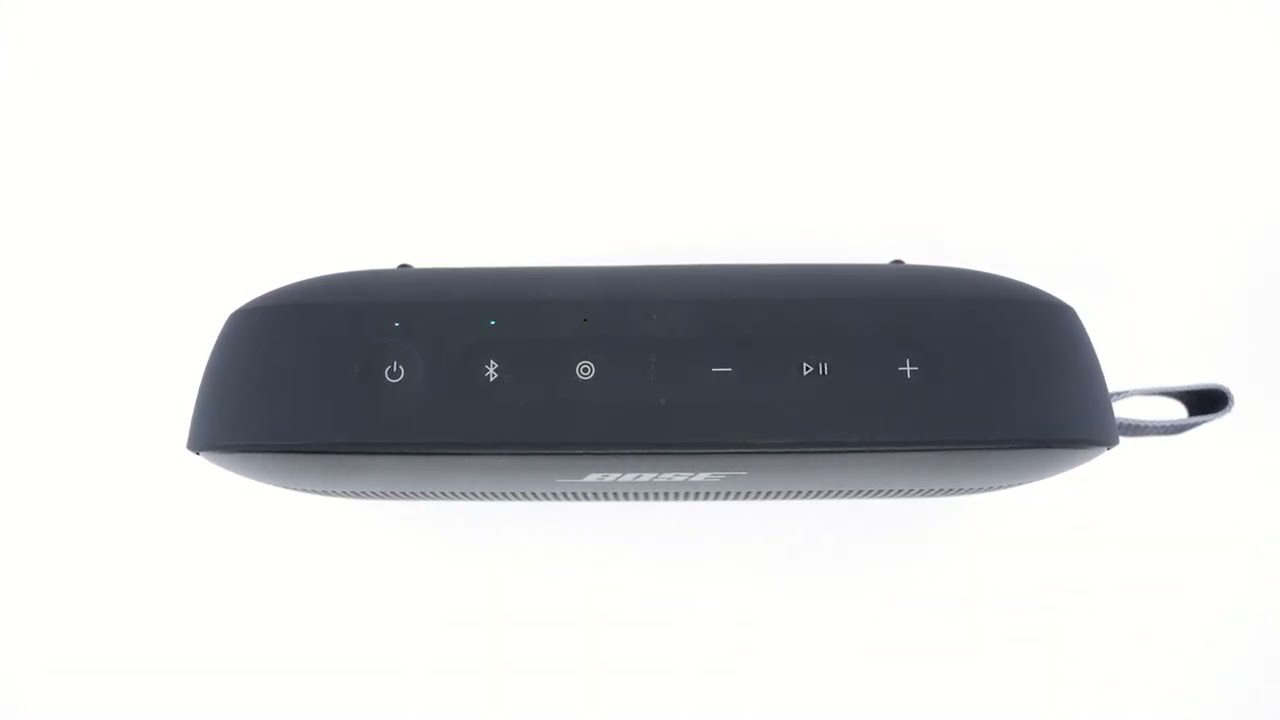
With two of the same model, press Shortcut once on either speaker to switch between Stereo and Party (opens in a new tab), or use Speaker Link in the Bose app. Different models play in Party mode only.
If the button opens a voice assistant or Spotify Tap instead, set it back to speaker linking under Shortcut in the Bose app. To unlink, press and hold Shortcut on either speaker.
Our Bose Flex 2 connection guide covers pairing your phone, plus SimpleSync, a separate way to link with compatible Bose smart speakers and soundbars.
Play to two speakers from a Galaxy phone
Galaxy phones and tablets with Dual Audio can play the same media through two connected Bluetooth audio devices from the Media output panel (opens in a new tab), which needs Android 10 or later.
- Pair both speakers with your Galaxy device, following each speaker's own pairing steps.
- Swipe down from the top right of the screen and tap Media output. Read the information and allow permissions if it asks.
- Find your connected Bluetooth audio devices and tick the circle next to each speaker.
- Play something and use the panel's volume controls to set the level. Check that both speakers are playing.
Can't select both? Check that your exact Galaxy model and software support Dual Audio before you pair again. You'll hear the same audio from both speakers, which is shared playback rather than a left and right stereo pair.
Auracast needs support at both ends
Auracast (opens in a new tab) broadcasts one audio stream to multiple compatible receivers, speakers included. The transmitter sends the audio, the receivers play it, and an assistant, such as a phone, gives you the controls to find and join a broadcast.
Your source has to transmit Auracast and every speaker has to receive it, so check both ends. Look for transmit support on the source itself, since assistant controls only help you find and join a broadcast. A Bluetooth version number won't settle it either, because Auracast needs specific features introduced in Bluetooth 5.2 plus the Public Broadcast Profile.
Whether an existing device ever gets an update depends on its hardware and its maker's plans, so buy for the support a device has today.
iPhone, Mac and syncing app options
Apple's Share Audio (opens in a new tab) is for compatible AirPods and Beats headphones with a supported iPhone or iPad, not for Bluetooth speakers in general.
AirPlay speakers work differently. Put your iPhone or iPad on the same network as the speakers, play music, open Control Center, tap AirPlay in the playback controls and select each speaker. This AirPlay route (opens in a new tab) only works with speakers that connect to your network.
On a Mac, the Apple Music app can play to multiple AirPlay speakers on the same network, but Control Center on a Mac can't.
A Mac can also combine outputs in Audio MIDI Setup (opens in a new tab). Connect the speakers first, then in the Audio Devices window, click Add > Create Multi-Output Device. Select the new device, tick Use next to each output you want and choose one in Primary Device.
Control-click the multi-output device, choose Use This Device for Sound Output (opens in a new tab) and play something. If a speaker is missing from the list, fix its connection first. Before you use this setup for video, check the timing with your actual speakers.
Check what a syncing app actually connects before you install it. AmpMe's Bluetooth method (opens in a new tab) uses a separate phone for each speaker, so it won't drive several Bluetooth speakers from one phone.
When it still doesn't sound right
Only one speaker playing from a Galaxy phone? Go back to Media output and tick both circles. Sony Party Connect group won't form? Recheck model compatibility, current speaker software, the 1-meter distance and stopped playback, then try again.
Both speakers playing but no left and right? Check that your pair supports stereo and that the stereo mode is selected before you pair again.
For TV and movies, we'd judge any setup by watching someone talk from your usual seat, since a music test won't show a lag and Sony warns that Party Connect can leave a gap between picture and sound. If the gap bothers you, try one speaker or another supported route.
If a compatible setup still won't work, contact support for your speakers or your source device, and give them the exact models, software versions, the connection feature you're using and which speakers play.
Explore the desk
Keep following the signal
Elsewhere on the desk